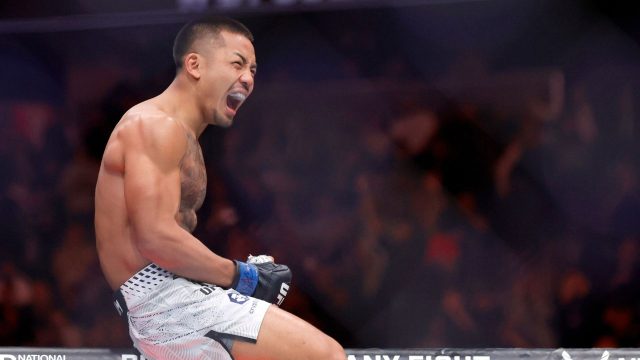
The best thing you can say about the flyweight title fight at UFC 323 is that it was great while it lasted. Alexandre Pantoja and Joshua Van absolutely threw down for all 26 seconds of it, exchanging heavy shots in both directions before the champion went for a head kick that the challenger caught and used to force him to the mat.
As Pantoja reached his left hand out to break the fall, his elbow bore the brunt of his body weight and bent in the opposite direction of the one elbows are meant to bend. Fight over. Pantoja’s reign halted. Van, the new flyweight champion. Just like that.
A freak injury is one of the last ways anyone wants to see a title change hands. But it happens. An unfortunate reality of professional sports. How long Pantoja’s sidelined is anyone’s guess — the extent of his injury hasn’t even been confirmed. But it’s safe to assume it’ll be a while before he can resume training, let alone step into an octagon for a deserved opportunity to fight for the belt he’d held for 30 months.
And in the meantime, the division must move on. Van took minimal damage in the fight and is an extremely active fighter as is — the Pantoja fight was his fifth in 12 months — so the UFC might as well get the 24-year-old turned around for his first title defence sometime early in the new year.
Who could that come against? That’s what we’re here today to explore. There are already two fights among top flyweight contenders booked for early 2026 — Kyoji Horiguchi vs. Amir Albazi and Asu Almabayev vs Brandon Moreno. So, they’re all out.
Meanwhile, Kai Kara-France has stepped away from the sport; Steve Erceg’s lost three of his last four; and Brandon Royval’s coming off a loss after getting stopped in the UFC’s final fight of the year last weekend. No options there.
That leaves only two fighters in flyweight’s current top-8 remaining. And you can make a decent case for either of them getting the first crack at UFC’s youngest champion.
Manel Kape
Recency bias is real and Kape has it in his corner after his first-round TKO of Royval on Saturday. That was the 32-year-old’s third consecutive stoppage victory over a ranked flyweight and second straight performance of the night. He has as much momentum as anyone in the division.
Kape’s path to this point has been a winding one after he made the jump from RIZIN — where he vacated a bantamweight title he’d just won — to the UFC early in 2020. His debut was twice delayed by injury and pandemic circumstances outside his control, and when he finally entered the octagon in 2021, he promptly dropped his first two fights.
Now, the missing context there is that the first was against Pantoja, who was beginning a run to becoming the second-greatest flyweight in the sport’s history, and the second was a razor-close short-notice fight against Matheus Nicolau that proved extremely challenging to judge and resulted in a controversial split decision. Not for nothing, all 22 media members who submitted scorecards to MMA Decisions prior to the result being read ruled the fight in Kape’s favour.
So, one loss that aged as well as possible and another that most believed was questionable. Undeterred, Kape ran off four straight wins from there over the next three years. But again, that doesn’t tell the full story. Interspersed between those victories were seven fight cancellations, two weight misses, and an unusual USADA drug test finding that didn’t cross the threshold for suspension but did require Kape to complete a six-month monitoring program.
Perhaps you’ve picked up on Kape’s career constant — weirdness follows him everywhere.
He culled controversy on either side of his UFC 293 win over late replacement Felipe dos Santos, throwing a water bottle at his original opponent — Kara-France — prior to the fight and using a homophobic slur to taunt him afterwards. Kape tried to fight his UFC 304 opponent, Muhammad Mokaev, in a hotel hallway during fight week, sparking a brawl days before his unanimous decision loss. His win over Bruno Silva in 2024 saw Kape absorb a trio of groin strikes, producing a point deduction for his opponent.
And incredibly, Kape was the catalyst for the fateful series of events that led to Van ending Pantoja’s generational run. After a broken foot in training forced Kape out of a fight with Royval in June, Van stepped in, won in a fight of the year candidate, and platformed that into his title shot and victory over Pantoja this month.
So, naturally, after stopping Royval on Saturday, Kape tried to reinsert himself among the title picture in the oddest way possible:
“Now baby, hey, listen, very well. I’m here, your daddy,” Kape said to Van through the camera. “Your daddy’s going to take your diapers, alive. On the new deal, Paramount deal. I’m going to take your diapers, alive. Be ready.”
And he wasn’t done there, asserting later that not only is he Portugal’s second-most famous sporting figure after Cristiano Ronaldo, but he’s also the UFC’s most marketable fighter in Japan, where “people ask me to put a hand on the bellies of [pregnant women] so their kid’s born as a samurai.”
He’s a madman. One who must create an interesting promotional conflict for UFC when considering him for a title shot, between his undeniable entertainment factor and the riskiness of what he might say or do, jeopardizing the fight. Wherever they land, Kape’s firmly in the conversation now. Although there’s another fighter on the rise who might provide the self-proclaimed “king” of Japan a challenge for both that title and Kape’s championship opportunity.
Tatsuro Taira
What better way for UFC’s first champion born in the 2000’s — and first to even challenge for a belt — to begin their reign than against another early Gen Z’er? That’s what Van would get in Taira, a 25-year-old Japanese transplant who’s run his record to 18-1.
A constant takedown threat with silky smooth transitions and lightning-quick back takes, Taira poses a dynamic challenge for any opponent who lets him get within grappling range. He’s won UFC fights via armbar, triangle, and face crank, not yet needing to reach into the deep bag of chokes he possesses among his submission arsenal. And he has demonstrated an evolving stand-up game and continued to show striking developments throughout his rise as a prospect.
Of course, it’s probably a stretch to still be referring to Taira as a prospect at this point. He already has 9 fights in the UFC after debuting in the promotion when he was just 22. And he began fighting at a high level long before that, as a 16-year-old in Japan’s Shooto organization.
He ripped through nine amateur fights in less than a year — undefeated, of course — before turning professional at 18 and running his Shooto record to 10-0 over the next four years. That’s when the UFC came calling and Taira immediately announced his presence with dominant victories in his first five contests. That earned him his first big opportunity against one-time flyweight title challenger Alex Perez, whose knee buckled under Taira’s weight in a takedown, resulting in a second-round TKO.
Taira’s lone setback came next, in a thrilling, five-round fight of the night against Royval, which he dropped in a razor-thin split decision — 48-47, 48-47, 47-48 — for his first career loss. But he’s since bounced back with two straight TKOs, spoiling Hyun-sung Park’s undefeated record before dominating the one-time flyweight champion Moreno at UFC 323.
Talk about a resume for a 25-year-old. Three of Taira’s last four opponents have either fought for his division’s title or held it. And his lone loss in that run was extremely competitive. There’s little else he could do to earn a title shot short of defeating Royval in a rematch.
But Royval has already had a crack against Van and came up short. You could insist that Taira first face Albazi to determine the next title challenger. They were booked to fight in August before Albazi was pulled during pre-fight medical screening. But Albazi’s now booked against Horiguchi, and he dropped a unanimous decision to Moreno, who Taira just ran through.
Ultimately, if Taira’s time isn’t now, it will be soon. His talent and record are undeniable and he’s still years away from what ought to be his competitive prime. UFC President Dana White recently indicated the promotion’s interest in returning to Japan and you can bet they’d want to make Taira a focal point of that event.
Taira challenging Myanmar’s Van in Tokyo would be a fitting way to top an Asian card. As would Taira vs. Horiguchi in a clash of headliners from Japan’s new and old guard. And depending on how the UFC plays its cards, it’s possible that the matchup could take on even more weight with a title on the line.